
The Village be the Place

Last weekend, I stayed with friends. There were multiple children, multiple dogs, very little sleep, an endless task list of various bodily fluids and spillages to clear up and at one point a toddler ate something off the floor that I’m trying my best to forget about.
It was, genuinely, one of the best weekends I’ve had in a long time.
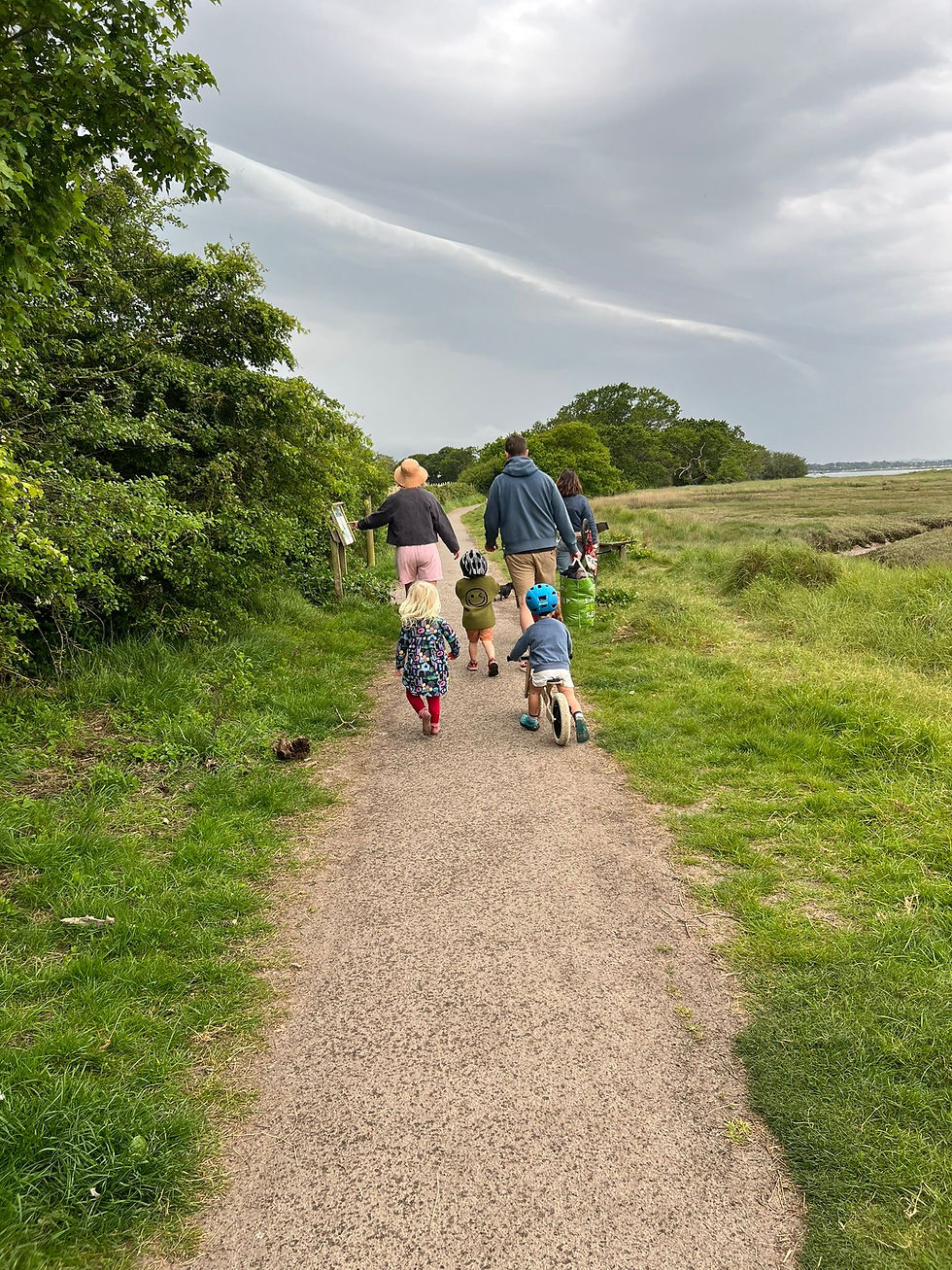
Not because it was restful (hard no). Not because everything went smoothly. (It absolutely didn’t). But because for a whole weekend, nobody was pretending. Nobody was performing. We were all just… in it together. Helping, muddling through, laughing at the bat shit chaos rather than quietly drowning in it alone.
And I’ve been thinking about it ever since - especially as last week was Maternal Mental Health Week - and I think my weekend of community and chaos holds something important.
Where are we actually at?
Maternal mental health gets talked about more than it used to. There are campaigns, awareness days, conversations happening that simply weren’t there a decade ago (when I became a mum). And that matters, it really does.
But if I’m honest with you it still feels profoundly taboo in the everyday. Not in the headline sense, but in the quiet, ordinary moments of actual real life.
In the gap between what we post and what we feel. In the smile at the school gates when everything inside is fraying. In the way we answer “how are you doing?” with “yes, fine, all good” because the truth feels too much, too heavy, too likely to make things awkward.
Social media doesn’t help - and I say this as someone who uses it, values it, and has found genuine community through it. But the version of motherhood most visible online is still one of soft lighting and affectionate eye rolls at the ‘chaos’, of hard things made picturesque in neutral tones, of struggle that resolves neatly by the end of the caption. And when that’s the water we’re swimming in, it’s very hard not to measure our own messy, unresolved, ongoing experience against it.
The result I see? So many women I work with - smart, capable, deeply loving, brilliant mothers - carry a belief so embedded they often can’t even name it at first. The belief that they are not quite worthy of help. That asking for support is an admission of failure. That needing people means they’re not coping well enough, not managing well enough, not enough full stop.
And here’s what I think is really at the nub of it - something I’ve been sitting with after conversations with friends and clients recently. It isn’t just the big cultural stuff. The campaigns, the awareness days, the wider narrative around coping. Those matter, but they can’t do the work that needs to happen on the inside.
Because as mothers, most of us are operating in fairly high-stress mode most of the time - juggling all the plates, planning, organising, keeping things going, while also being the emotional container for our children. And in that state, we react, of COURSE. We snap, we boil over, we feel jealous of the mum who looks like she’s got it all together. We feel the sting of expectation versus reality - in work, life, parenting. We feel guilt and shame for going to work, for not going to work, for not being the mother we thought we would be.
These are normal, natural, deeply human reactions to emotionally charged situations - which, let’s be honest, is the entirety of motherhood. If one of my closest friends told me she’d shouted, or felt jealous, or felt sad about something she thought she’d have by now, there is not one part of me that would jump in and say but you should be grateful, look what you’ve got, you chose this! I would hold her (metaphorically or actually). I’d listen, I’d support her, I’d understand, I’d hand her a cup of tea.

But I wonder how many of us have a very different voice running in our own heads. One that does exactly that. I call these our shadow thoughts - the thoughts that jump in before you’ve even had a moment to catch them, that rip apart the very normal, very human way you just reacted to a stressful situation. They’re the inner critic that says: you should be doing better than this. You should be grateful. Look what you chose. And unlike something a friend might say, you can’t separate yourself from them. They are always in the room with you, always taking up valuable space in your head.
It is these shadow thoughts, more than anything else, that I believe, stops women from reaching out. Not the absence of support, not the logistics, not the systemic failures around supporting and valuing motherhood - although these provide huge barriers to finding that village too. I believe the biggest factor is this shadow voice that has quietly, persistently decided that you don’t deserve it.
That belief is, in my view, one of the most quietly damaging things in modern motherhood and it’s what I spend a lot of my work trying to gently, carefully unpick and quieten this dark influential force in the mums I work with.
So. The village.
We talk about the village a lot (I mean, it’s my entire thing here really). Because I do really truly honestly believe, it takes a village - we say it, we share it, we nod along. But I think it has 100% become a bit of a platitude - something we agree with in theory while quietly assuming it doesn’t really apply to us, or that our village is assembled by now and we should be getting on with it. I think sometimes, we are in fact our own gatekeepers to the village.
What struck me about last weekend wasn’t the practical help - although that was real and very very welcome (especially during operation cleanup unidentifiable puddle). It was something underneath the spare pairs of hands and helpers that really stuck with me.
It was being seen.
Seen in the mess. Seen in the struggle. Seen by people who didn’t need me to be fine, or smashing it, who weren’t waiting for me to pull it together, who were right there in the same mad chaos and not judging any of it - floor snacks, snotty noses, meltdowns and all.
That is what the village actually is, at its best. Not just hands to help with the practical load but a place where you are known and accepted as you actually are right now. Not a curated, managed version, the real deal, in all her complicated, tired, covered in lord knows what glory.
And when you have that - when you genuinely feel it - something shifts. The belief that you’re not worthy of help starts to lose its grip. Because you’re experiencing the opposite, in real time. You’re letting people in, and the world hasn’t ended. In fact, it’s got easier, lighter and given you the breathing space to even laugh at this mayhem in front of your eyes.
This is why I keep coming back to it.
The village isn’t a nice-to-have. It isn’t a luxury for people whose lives happen to be set up that way. It’s the environment in which women start to really believe that they deserve support and that asking for it isn’t weakness, that they don’t have to hold everything alone.
And right now, so many mothers are trying to do exactly that - looking at a version of motherhood online that doesn’t look like their life and concluding that something must be wrong with them, rather than with the comparison.
Well here’s a reality check - there isn’t anything wrong with what you’re doing. There really, truly isn’t.
You are not behind. You are not failing. You are not the only one whose kitchen looks like that, whose patience ran out earlier than you wanted it to, whose identity sometimes feels like it got decimated somewhere around the first year and hasn’t ever really found its way back.
What you might be, is without enough village. Without enough people who know the real version of you, who normalise the struggle, who let you off the hook of performing ‘I’m fine!’ all the time.

But you might also be getting in your own way of receiving that help - through the quiet voices in your head that tell you ‘you don’t deserve to ask for help, you should just crack on, isn’t this what you wanted? Stop complaining!’
If any of those phrases ever pop up in your subconscious, let me just come back with: What you feel is all valid, worthy of paying attention to and should be treated with kindness, compassion and a cup of tea.
So if any of this resonates, I am here to meet you exactly where you are and challenge these shadows with the strength of the village. You can book a (no obligation) chat with me anytime via my website.
Let’s make sure the big conversations around maternal mental health start with the quiet inner chatter that lives in our own heads. I’ll put the kettle on.


Comments